World models predict future observations from current experience and actions, yet prediction can depend
on observations seen far in the past. Episodic memory preserves past observations for later recall;
however, as memory accumulates, it raises a fundamental question:
Which memories are useful for the current prediction, and
which retrieval cues should be trusted to find them?
Fixed criteria based on recency, pose overlap, or visual similarity are unreliable across environments
and queries. Future-Aware Recall (FAR) instead learns
recall: during training, the realized future reveals which memories actually helped the prediction, and
that signal trains a retriever that stays future-blind at inference and learns which cues to trust for
each query.
Across three complementary settings, FAR outperforms hand-designed recall even with the same retrieval
cues, automatically adapts which available cues to trust, and recalls the right history as the world
changes. Together, these results establish FAR as a flexible, principled approach to episodic memory
access in world models.
Method
Future-Aware Recall
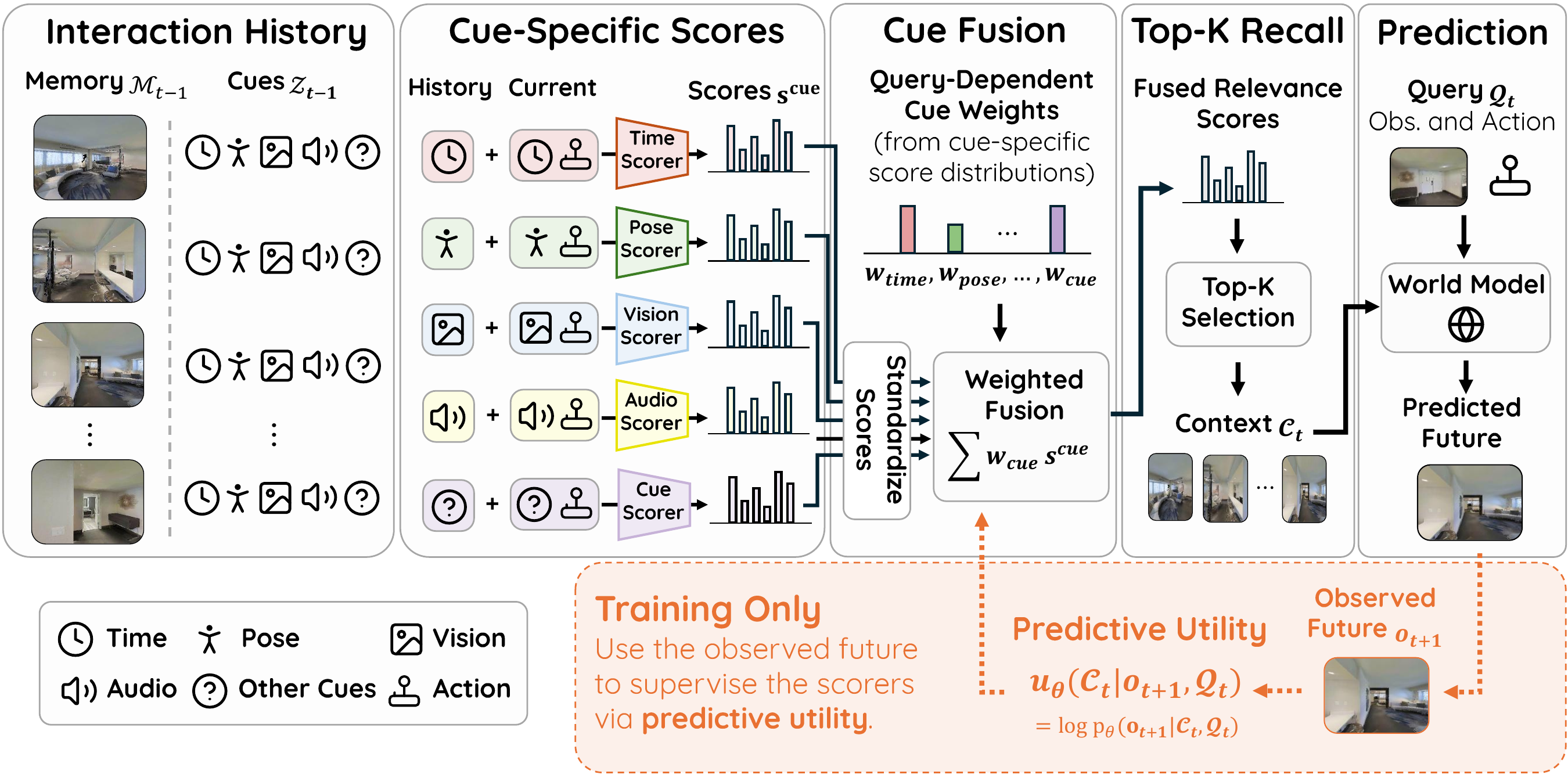
During training, the realized future supervises the scorers through predictive utility; at inference, recall is future-blind.
1Predictive utility
A memory is worth recalling when conditioning on it makes the realized future more likely under the
world model.
2Future-aware supervision
During training the observed future re-ranks the candidate memories, and the retriever learns to match
that ranking without ever seeing the future at test time.
3Adaptive cue fusion
A learned gate weights time, pose, vision, audio, and any other cue per query, leaning on whichever
is most trustworthy.
Experiments
Results
Three complementary settings, each with a different source of long-horizon uncertainty:
LoopNav, a static outdoor Minecraft environment with time, pose, and visual cues;
SoundSpaces, realistic indoor scenes with spatialized audio; and AI2-THOR, interactive
household scenes whose state changes with the agent's actions.
Every trajectory has an exploration phase, in which the agent observes and, where applicable,
interacts with the environment, and a return phase, in which it revisits explored locations.
The world model generates the return-phase video using the exploration-phase observations as its memory
pool, and we measure frame-wise discrepancy against ground truth.
Example evaluation trajectories
These are ground-truth episodes from the evaluation sets, not model rollouts. Each shows the
exploration phase, which fills the episodic memory, followed by the return phase that the world model is
asked to predict. Generated rollouts are shown further below, per dataset.
LoopNav (ground truth). Exploration, then return.
SoundSpaces (ground truth). Exploration, then return. 🔊 Has sound. Click the speaker icon in the controls to hear the spatialized audio the agent uses as a retrieval cue.
AI2-THOR (ground truth). Exploration with object interactions, then return.
LoopNav
FAR outperforms hand-designed recall
A static outdoor Minecraft environment with procedurally generated navigation, where retrieval can use time,
pose, and visual cues. Each block of the reel shows the ground-truth frame, then for FAR, Temporal,
WorldMem, and LongLive-RAG the prediction and the four recalled memories with their time offsets. Red shading marks where a prediction differs from the ground truth. It is an error overlay
drawn for visualization, not something the model generated. FAR reaches 20 to 40 seconds back for the frames
that matter, while the baselines mostly recall the last few seconds.
DreamSim at loop closure ↓ perceptual distance to the ground truth when the agent returns to its starting point; lower is better
0.200
Temporal
0.133
LongLive-RAG
0.130
WorldMem
0.082
FAR (ours) · 37% lower than the best baseline
Show full LoopNav rollouts (4 uncut episodes)
Full return-phase rollouts. Press play on a video to watch it; use the controls to scrub or go fullscreen.
LoopNav, episode 12
LoopNav, episode 1656
LoopNav, episode 2259
LoopNav, episode 3106
SoundSpaces
FAR adaptively learns which cues to trust
Realistic indoor navigation with spatialized audio. Each block shows the ground-truth frame, then for each
method the prediction and the recalled memories with their time offsets. Red shading marks
where a prediction differs from the ground truth. It is an error overlay drawn for visualization, not
something the model generated. Where pose and appearance are ambiguous along a corridor, FAR learns to rely
on audio and recalls a memory with a clear line of sight to the goal region.
DreamSim near loop closure ↓ perceptual distance to the ground truth over the final quarter of the return phase; lower is better
0.452
Temporal
0.423
WorldMem
0.150
FAR (ours) · 65% lower than the best baseline
Show full SoundSpaces rollouts (4 uncut episodes)
Full return-phase rollouts. Press play on a video to watch it; use the controls to scrub or go fullscreen.
SoundSpaces, episode 84
SoundSpaces, episode 99
SoundSpaces, episode 212
SoundSpaces, episode 1115
AI2-THOR
FAR recalls the right state as the world changes
Interactive household scenes where the agent moves objects between surfaces and containers during
exploration, so memory holds the same place in conflicting world states. Each block shows the ground-truth
frame, then for each method the prediction and the recalled memories with their time offsets; a badge on
each prediction says whether the rendered state matches the world the agent left behind. FAR recalls the
frames from the interaction itself rather than a pose-matched but stale view.
State-change prediction accuracy ↑ fraction of revisited scenes where the world model renders the changed state rather than the stale pre-interaction one; higher is better
Temporal
WorldMem
FAR (ours)
Surface changes
5.7%
42.1%
80.2%
Container reveals
0.6%
12.5%
75.7%
FAR is 1.9× the best baseline on surface changes and 6× on container reveals, where the contents only become visible after opening.
Show full AI2-THOR rollouts (3 uncut episodes)
Full return-phase rollouts. Press play on a video to watch it; use the controls to scrub or go fullscreen.
AI2-THOR, episode 309
AI2-THOR, episode 350
AI2-THOR, episode 430
Off-scene dynamics prediction
A controlled two-agent corridor: the observer sees a second, independently patrolling agent only
intermittently through a doorway, and must later predict where that agent is when looking down the
corridor. Each recalled context is a pair of observations about 1.5 seconds apart so it can carry motion.
Predicting the patrolling agent’s future location ↑ trajectory-level accuracy; higher is better
41.9%
Temporal
32.4%
WorldMem
67.1%
FAR, time & pose
94.6%
FAR, + agent cue
Off-scene dynamics, episode 47. Return-phase rollout in the two-agent corridor. FAR recalls a
motion-informative episode containing the second agent and predicts where it will be; WorldMem retrieves a
spatially relevant but dynamically uninformative memory.
Discussion and limitations
FAR learns both which episodic memories are useful for prediction and which retrieval cues to trust. It
uses the observed future during training to assign predictive credit while remaining future-blind at
inference, and its adaptive cue fusion lets it exploit time, pose, vision, audio, or any other signal
attached to a memory. Across navigation, multimodal, and changing-state environments, this consistently
improves long-horizon prediction and supports predictive utility as a principled basis for episodic
memory access in persistent world models.
Our work focuses on the recall problem and assumes an external episodic memory. How memories are written,
compressed, or forgotten, and how interactions among multiple memories are credited beyond our
candidate-level approximation, remain open. FAR relies on informative retrieval cues and adds training-time
computation for future-aware utility evaluation, though inference is unchanged. Our experiments are in
controlled simulation; extending predictive episodic recall to richer real-world settings, together with
learned memory formation and persistent-state representations, is a natural next step.
BibTeX
@article{kim2026learning,
  title   = {Learning What to Recall: Adaptive Multi-Cue Episodic Memory for World Models},
  author  = {Kim, Beomsu and Lai, Chieh-Hsin and Nguyen, Bac and Bar, Amir and Ye, Jong Chul and Mitsufuji, Yuki},
  journal = {arXiv preprint arXiv:2609.34677},
  year    = {2026}
}